






Support for Focus: The Best Supplements for Attention
Modern life strains attention, but brain-focused nutrition can help. Discover science-backed supplements that support focus, mood, and long-term cognitive health.

Sorry, looks like we don't have enough of this product.


For many women, brain fog builds gradually. At first, it shows up through minor inconveniences: losing your train of thought or the right words mid-sentence, or even struggling to concentrate on tasks that once felt simple. Over time, these moments start to become more frequent and harder to ignore.
During perimenopause and menopause, these cognitive changes are common. In fact, studies suggest that up to two-thirds of women report some memory, focus, or mental clarity issues at this stage of life (Greendale et al., 2010; Weber et al., 2013).
That’s why so many begin looking for the best supplements to help them manage menopause. Understanding what’s happening in the body, and which approaches are most relevant for supporting brain function over time, can help you to identify the best supplements for cognitive support during times of transition.
Brain fog during menopause is common and often linked to a combination of hormonal changes, lifestyle, and nutritional factors.
Not all supplements offer the same support. Absorption, bioavailability, and formulation are differentiators.
Omega-3s, B vitamins, and minerals support different aspects of cognitive function.
A structured, combination approach is often more effective than relying on a single supplement.
Most women don’t initially describe these changes as “brain fog.” Instead, they tend to feel like:
Slower thinking or reaction times
More effort is required to hold attention
Reduced mental clarity
Struggling to switch between tasks
You can still perform your daily activities, but not as efficiently as before. Even simple tasks can feel more demanding, especially when you’re juggling multiple responsibilities.
Oestrogen plays a role in neurological function, including memory and mood, and has been shown through research to influence neurotransmitter activity and brain signaling (Brinton, 2009; Henderson, 2014).
Several overlapping contributors influence it:
Poor sleep (often linked to night sweats)
Higher stress levels
Changes in mood
Nutritional gaps
Blood sugar fluctuations
As we age, metabolic and cellular processes can become less efficient, which has been associated with changes in brain energy metabolism and cognitive performance (Peters, 2006).
When this process becomes less efficient, it can contribute to:
Slower processing speed
Reduced mental stamina
Difficulty concentrating
Sleep disruption is one of the most significant contributors to brain fog. Research suggests even modest reductions in sleep quality can affect attention, memory, and cognitive performance (Killgore, 2010).
Chronic stress has also been shown to influence attention, memory, and overall cognitive function (McEwen, 2017).
Before considering brain supplements, it’s important to address the lifestyle factors that have the strongest influence on brain health:
A balanced diet
Regular physical activity
Consistent, high-quality sleep
Earlier in life, the body can often compensate for dietary inconsistencies. Over time, that flexibility decreases. As a result, nutritional gaps may begin to affect how the brain functions.
For many women, this is where targeted supplementation becomes more relevant, especially when deficiencies or increased demands are present.
When evaluating the best supplements for menopause brain fog, the difference is how that ingredient is delivered and used by the body.
Two supplements can contain the same nutrient but perform very differently depending on how well the body absorbs them. Research suggests that certain bioavailable forms, such as methylated B vitamins or chelated minerals, may be more efficiently utilized in some individuals (O’Leary & Samman, 2010).
This becomes especially relevant when looking at omega-3s.
The body handles different forms in different ways. It absorbs some well but doesn’t use them as efficiently in the brain, while it transports and utilizes others more effectively because of how they’re structured (Bazinet & Layé, 2014).
Brain function depends on multiple systems working together:
Structure: fats (omega-3s)
Energy: vitamins
Regulation: minerals
Supplementing with only a single nutrient rarely addresses the full picture. A more structured approach tends to be more effective over time.
Creatine is increasingly being discussed in relation to cognitive performance. It plays a role in cellular energy production by helping regenerate ATP, the brain's primary energy source.
Some early research suggests it may support:
Mental energy
Cognitive performance under fatigue
However, evidence in women going through menopause is still limited. At this stage, creatine is best viewed as a potentially helpful addition.
Omega-3 fatty acids are components of brain cell membranes. They're important for overall brain health, as well as:
Heart health
Mood regulation
General wellbeing
However, not all omega-3s are equivalent. Fish oil supplements can vary in absorption and use. In many cases, standard formulations aren’t specifically designed for efficient brain delivery, which can limit how effectively they support cognitive function.
LYSOVETA® LPC (lysophosphatidylcholine-bound omega-3s) is a specific form of omega-3 that aligns more closely with how the body naturally transports omega-3s to the brain. This distinction matters, as brain function depends on targeted delivery rather than simply increasing circulating omega-3 levels.
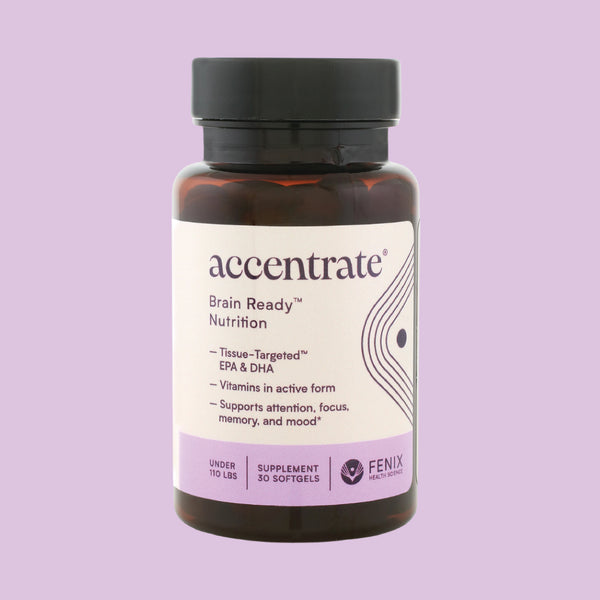
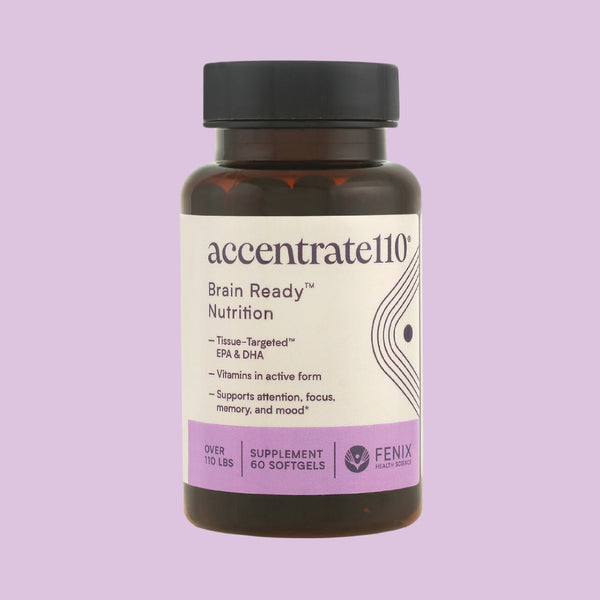
Formulations such as Accentrate Omega 110 and Accentrate Omega Max optimize brain availability, prioritizing how omega-3 fatty acids are delivered and utilized.
B vitamins are central to energy metabolism and neurotransmitter production. Low levels, particularly B12, are associated with fatigue and cognition challenges in some people.
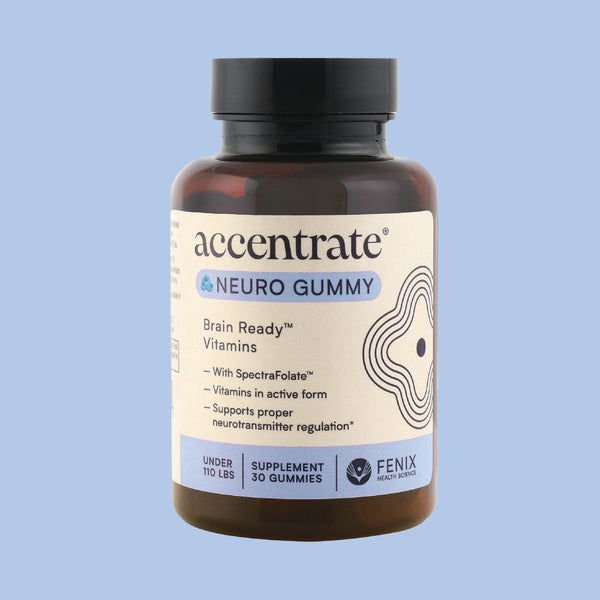
Formulations that use active, bioavailable forms (such as methylfolate and methylcobalamin) may be more effective in supporting these processes. Accentrate Neuro and Accentrate Neuro 110 incorporate these forms, supporting mental energy and cognitive function where nutritional demands are higher.
Magnesium influences nervous system regulation and is closely linked to sleep and stress response.
This makes it particularly relevant for women experiencing:
Sleep disturbances
Increased stress
Difficulty relaxing
Chelated forms, such as magnesium bisglycinate, are generally well absorbed and better tolerated. Our Minerals Products provide essential minerals in these forms, supporting nervous system balance and overall function.
Terms like “menopause relief” or “brain support” can be vague. Instead, look at:
Nutrient form
Absorption
Relevance to your needs
Supplements aren't immediate solutions. Most require consistent use over several weeks, and results vary.
Supplements work best alongside:
A balanced diet
Regular movement
Good sleep habits
Don't ignore persistent or worsening brain fog.
It’s important to rule out underlying conditions such as:
Thyroid disorders
Vitamin B12 deficiency
Anaemia
Blood sugar issues
Sleep disorders
Anxiety or depression
A healthcare professional can guide appropriate testing and treatment if needed.
Supplements can support overall health, but they are not a replacement for medical care or foundational lifestyle habits. Research suggests their benefits are often most noticeable in individuals with nutrient deficiencies or low dietary intake (NIH Office of Dietary Supplements, 2022).
Brain fog during menopause is common, but it rarely has a single cause. It’s typically the result of overlapping factors, including hormonal changes, sleep disruption, stress, and nutrition.
The most effective approach focuses on the bigger picture: supporting overall health, addressing lifestyle factors, and using supplements where they are most relevant.
For women looking for a more structured approach, Fenix Health’s formulations are designed to simplify this process through bioavailability, targeted nutrients, and combining key systems into a practical, cohesive strategy for long-term cognitive support.
Bazinet, R. P., & Layé, S. (2014). Polyunsaturated fatty acids and their metabolites in brain function and disease. Nature Reviews Neuroscience, 15(12), 771–785.
Boyle, N. B., Lawton, C., & Dye, L. (2017). The effects of magnesium supplementation on subjective anxiety and stress: A systematic review. Nutrients, 9(5), 429.
Brinton, R. D. (2009). Estrogen-induced plasticity from cells to circuits: Predictions for cognitive function. Trends in Pharmacological Sciences, 30(4), 212–222.
Dyall, S. C. (2015). Long-chain omega-3 fatty acids and the brain: A review of the independent and shared effects of EPA, DPA and DHA. Frontiers in Aging Neuroscience, 7, 52.
Greendale, G. A., Huang, M. H., Wight, R. G., Seeman, T., Luetters, C., Avis, N. E., Johnston, J. M., & Karlamangla, A. S. (2010). Effects of the menopause transition and hormone use on cognitive performance: Results from the Study of Women’s Health Across the Nation. Neurology, 75(23), 2115–2122.
Henderson, V. W. (2014). Alzheimer’s disease: Review of hormone therapy trials and implications for treatment and prevention after menopause. Journal of Steroid Biochemistry and Molecular Biology, 142, 99–106.
Killgore, W. D. S. (2010). Effects of sleep deprivation on cognition. Progress in Brain Research, 185, 105–129.
McEwen, B. S. (2017). Neurobiological and systemic effects of chronic stress. Chronic Stress, 1, 1–11.
Nguyen, L. N., Ma, D., Shui, G., Wong, P., Cazenave-Gassiot, A., Zhang, X., Wenk, M. R., Goh, E. L. K., & Silver, D. L. (2014). Mfsd2a is a transporter for the essential omega-3 fatty acid DHA across the blood–brain barrier. Nature, 509(7501), 503–506.
Nichols, P. D., Petrie, J., & Singh, S. (2014). Long-chain omega-3 oils—An update on sustainable sources. Nutrients, 2(6), 572–585.
NIH Office of Dietary Supplements. (2022). Dietary supplements: What you need to know. National Institutes of Health.
O’Leary, F., & Samman, S. (2010). Vitamin B12 in health and disease. Nutrients, 2(3), 299–316.
Peters, R. (2006). Ageing and the brain. Postgraduate Medical Journal, 82(964), 84–88.
Rae, C., Digney, A. L., McEwan, S. R., & Bates, T. C. (2003). Oral creatine monohydrate supplementation improves brain performance: A double-blind, placebo-controlled, cross-over trial. Proceedings of the Royal Society B, 270(1529), 2147–2150.
Smith, A. D., & Refsum, H. (2016). Homocysteine, B vitamins, and cognitive impairment. Annual Review of Nutrition, 36, 211–239.
Weber, M. T., Maki, P. M., & McDermott, M. P. (2013). Cognition and mood in perimenopause: A systematic review and meta-analysis. Menopause, 20(10), 1091–1103.
These statements have not been evaluated by the Food and Drug Administration. This product is not intended to diagnose, treat, cure, or prevent any disease.
